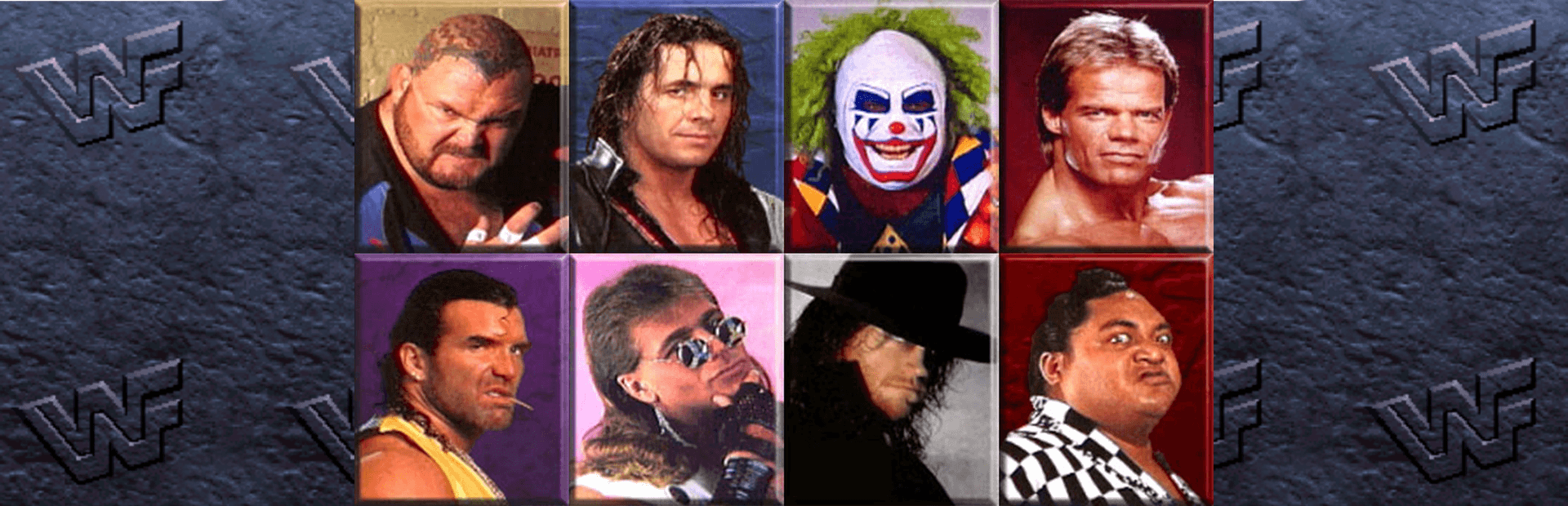
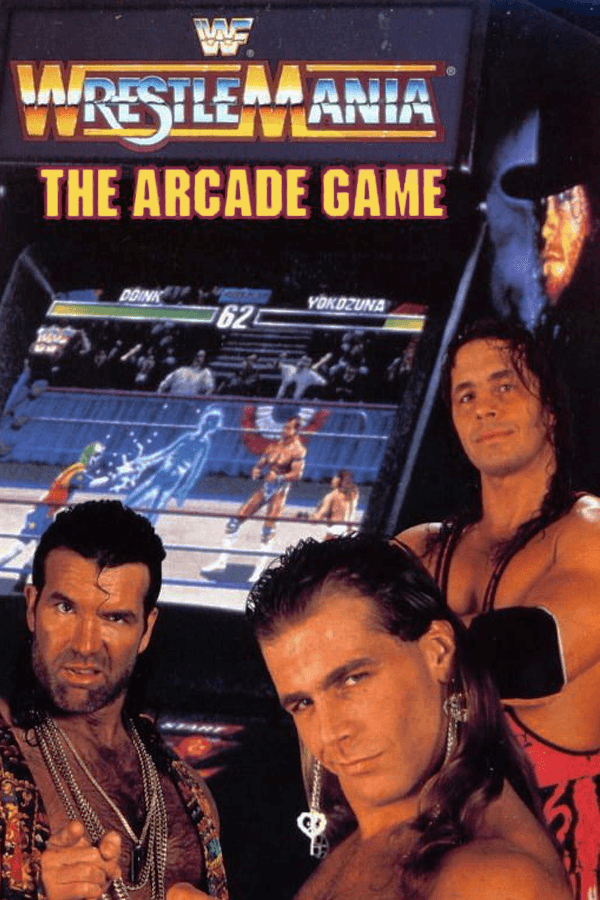
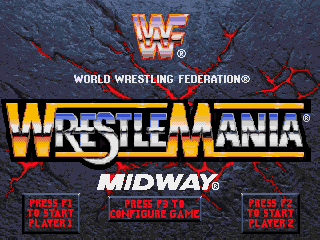
If you loaded up WWF WrestleMania: The Arcade Game expecting a realistic simulation of ring psychology, you were in for a rude awakening. Midway took eight digitized wrestling stars, dumped them into a fighting game engine, and let players throw fiery punches that shattered opponents like glass.
Most wrestling titles from the mid-nineties asked you to wear down an opponent with grapples, Irish whips, and carefully timed working holds. Midway lead designer Mark Turmell threw all of that out. Instead, his team built a game that plays far closer to Mortal Kombat than traditional professional wrestling. Rounds end when health bars empty, juggles keep opponents suspended in mid-air, and special moves look like cartoon violence brought to life.
You choose from eight wrestlers, each captured through digitized sprite frames. Instead of realistic reversals, you execute multi-hit combo chains by snapping off rapid button sequences. A single misstep can trap your character in an endless sequence of dizzying overhead slams. It moves fast, gets chaotic, and refuses to give you a second of breathing room.
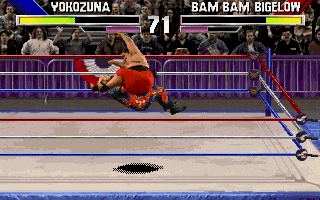
The core mechanics force an aggressive style. You cannot sit back and wait for an opening because the ring is small and movement is blistering. Every character can run, bounce off the ropes, and inflict outrageous airborne punishers. It trades tactical wrestling depth for pure, fast-paced arcade adrenaline.
The roster might seem small at just eight wrestlers, but each character plays with completely exaggerated quirks. Doink the Clown hits people with a giant joy-buzzer and pulls a massive wooden mallet out of thin air. Razor Ramon turns his forearm into a literal steel blade. Bam Bam Bigelow lights his own gloves on fire to deliver rapid-fire punches.
The visual flair extends to every hit. Whenever a superstar takes damage, ridiculous themed objects spray out of their body instead of blood.
Behind those digitized sprites lies a classic production story. Legend has it that The Undertaker refused to shoot his digitized motion capture frames until Midway supplied him with a bottle of Jack Daniel's whiskey. The developers also planned to include Adam Bomb as a hidden character, but they scrapped him late in development because his graphical assets were never finished.
Single-player play splits into two distinct campaign ladders: the Intercontinental Championship and the WWF Championship. The early 1-on-1 matches in the Intercontinental mode give you room to learn your character's move set. Once you advance past those four warm-ups, the game drops any pretense of fairness.
The real nightmare begins when the CPU starts pairing opponents against you in handicap matches. The WWF Championship ladder forces you through four 2-on-1 fights and two 3-on-1 fights before opening up the final gauntlet. In that last WrestleMania Challenge, you must wipe out the entire eight-man roster sequentially as fresh wrestlers sprint down the aisle to replace the fallen ones.
Handling three aggressive arcade-grade computer opponents at once borders on cruelty. They corner you in seconds, pin you against the ropes, and loop juggle attacks until your life bar disappears. If the pressure gets too ridiculous, you can pause the action and type hulkhoganwearsyellownickers to instantly claim victory, a classic secret code that saved many a keyboard from destruction.
Porting an arcade machine to home hardware in 1995 was always a exercise in compromise. Sculptured Software handled the translation for publisher Acclaim Entertainment, bringing the side-view action to desktop computers. Graphically, the MS-DOS game matched the arcade sprites impressively well, maintaining smooth animation frames and bright colors.
The audio side took a clear hit during the move to PC. While the original cabinet utilized raw digitized redbook audio tracks, the MS-DOS CD-ROM release converted the soundtrack into General MIDI music. On a standard Sound Blaster card, the background tunes sound thin compared to the heavy cabinet speakers, even if the digitized sound effects and voice commentary remained intact.
Control setups brought their own headaches for local multiplayer. Playing with two people on one keyboard often triggered hardware key-ghosting, where pressing multiple keys simultaneously caused input drops. PC gamepads at the time rarely offered enough buttons to map punch, kick, block, and speed controls comfortably. The game was brilliant when it worked, but hardware limitations made head-to-head computer battles a messy proposition.
Despite its absurd difficulty spikes and hardware quirks, it is still a blast for anyone who loves high-speed arcade action. It does not demand that you memorize complex wrestling maneuvers or manage stamina gauges. You simply pick your favorite wrestler, mash the attack keys, and watch tombstones and mallets fly across the ring.
If you want to experience this wild action game today, you can play WWF WrestleMania: The Arcade Game free in your browser right here. There is nothing to install, so you can jump straight into the ring within seconds. Grab Doink or Razor Ramon, launch a few wild flame punches, and see how long you survive against the brutal multi-wrestler handicap ladders.
If you loaded up WWF WrestleMania: The Arcade Game expecting a realistic simulation of ring psychology, you were in for a rude awakening. Midway took eight digitized wrestling stars, dumped them into a fighting game engine, and let players throw fiery punches that shattered opponents like glass.
Most wrestling titles from the mid-nineties asked you to wear down an opponent with grapples, Irish whips, and carefully timed working holds. Midway lead designer Mark Turmell threw all of that out. Instead, his team built a game that plays far closer to Mortal Kombat than traditional professional wrestling. Rounds end when health bars empty, juggles keep opponents suspended in mid-air, and special moves look like cartoon violence brought to life.
You choose from eight wrestlers, each captured through digitized sprite frames. Instead of realistic reversals, you execute multi-hit combo chains by snapping off rapid button sequences. A single misstep can trap your character in an endless sequence of dizzying overhead slams. It moves fast, gets chaotic, and refuses to give you a second of breathing room.
The core mechanics force an aggressive style. You cannot sit back and wait for an opening because the ring is small and movement is blistering. Every character can run, bounce off the ropes, and inflict outrageous airborne punishers. It trades tactical wrestling depth for pure, fast-paced arcade adrenaline.
The roster might seem small at just eight wrestlers, but each character plays with completely exaggerated quirks. Doink the Clown hits people with a giant joy-buzzer and pulls a massive wooden mallet out of thin air. Razor Ramon turns his forearm into a literal steel blade. Bam Bam Bigelow lights his own gloves on fire to deliver rapid-fire punches.
The visual flair extends to every hit. Whenever a superstar takes damage, ridiculous themed objects spray out of their body instead of blood.
Behind those digitized sprites lies a classic production story. Legend has it that The Undertaker refused to shoot his digitized motion capture frames until Midway supplied him with a bottle of Jack Daniel's whiskey. The developers also planned to include Adam Bomb as a hidden character, but they scrapped him late in development because his graphical assets were never finished.
Single-player play splits into two distinct campaign ladders: the Intercontinental Championship and the WWF Championship. The early 1-on-1 matches in the Intercontinental mode give you room to learn your character's move set. Once you advance past those four warm-ups, the game drops any pretense of fairness.
The real nightmare begins when the CPU starts pairing opponents against you in handicap matches. The WWF Championship ladder forces you through four 2-on-1 fights and two 3-on-1 fights before opening up the final gauntlet. In that last WrestleMania Challenge, you must wipe out the entire eight-man roster sequentially as fresh wrestlers sprint down the aisle to replace the fallen ones.
Handling three aggressive arcade-grade computer opponents at once borders on cruelty. They corner you in seconds, pin you against the ropes, and loop juggle attacks until your life bar disappears. If the pressure gets too ridiculous, you can pause the action and type hulkhoganwearsyellownickers to instantly claim victory, a classic secret code that saved many a keyboard from destruction.
Porting an arcade machine to home hardware in 1995 was always a exercise in compromise. Sculptured Software handled the translation for publisher Acclaim Entertainment, bringing the side-view action to desktop computers. Graphically, the MS-DOS game matched the arcade sprites impressively well, maintaining smooth animation frames and bright colors.
The audio side took a clear hit during the move to PC. While the original cabinet utilized raw digitized redbook audio tracks, the MS-DOS CD-ROM release converted the soundtrack into General MIDI music. On a standard Sound Blaster card, the background tunes sound thin compared to the heavy cabinet speakers, even if the digitized sound effects and voice commentary remained intact.
Control setups brought their own headaches for local multiplayer. Playing with two people on one keyboard often triggered hardware key-ghosting, where pressing multiple keys simultaneously caused input drops. PC gamepads at the time rarely offered enough buttons to map punch, kick, block, and speed controls comfortably. The game was brilliant when it worked, but hardware limitations made head-to-head computer battles a messy proposition.
Despite its absurd difficulty spikes and hardware quirks, it is still a blast for anyone who loves high-speed arcade action. It does not demand that you memorize complex wrestling maneuvers or manage stamina gauges. You simply pick your favorite wrestler, mash the attack keys, and watch tombstones and mallets fly across the ring.
If you want to experience this wild action game today, you can play WWF WrestleMania: The Arcade Game free in your browser right here. There is nothing to install, so you can jump straight into the ring within seconds. Grab Doink or Razor Ramon, launch a few wild flame punches, and see how long you survive against the brutal multi-wrestler handicap ladders.
How WWF WrestleMania: The Arcade Game is played — the keys the game listens to, grouped by what they do.
Highlighted keys are mapped — hover or tap one to see what it does.
Controls can be remapped via SETUP.EXE or options menus.
The on-screen keyboard and gamepad mapping the browser player uses on a phone, a tablet or a controller, as opposed to the real keys above. $PRO members make their own in the player and share them here; anyone can pick one to play with.
Cheat codes, console commands and memory pokes for WWF WrestleMania: The Arcade Game — each one verified and attributed.
Sign in to submitaka WWF WrestleMania
How WWF WrestleMania: The Arcade Game is played — the keys the game listens to, grouped by what they do.
Highlighted keys are mapped — hover or tap one to see what it does.
Controls can be remapped via SETUP.EXE or options menus.
The on-screen keyboard and gamepad mapping the browser player uses on a phone, a tablet or a controller, as opposed to the real keys above. $PRO members make their own in the player and share them here; anyone can pick one to play with.
Cheat codes, console commands and memory pokes for WWF WrestleMania: The Arcade Game — each one verified and attributed.
Sign in to submit