
In The Ancient Art of War at Sea, Dave and Barry Murry brought 18th-century naval tactics to life on a strategic map where a single bad gust of wind could wreck your flagship long before the cannons fired.
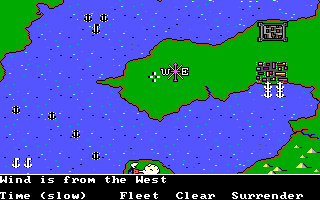
Launching The Ancient Art of War at Sea drops you straight onto a strategic chart with tiny ships creeping across the open ocean under dynamic wind conditions. Designed by brothers Dave and Barry Murry at Evryware and published by Broderbund, this sequel expands on their 1984 land-based wargame by introducing naval movement mechanics, shoals, and broadside combat. You control a fleet composed of fast Frigates, heavy Ships-of-the-Line, and massive Flagships. You cannot build replacements, so keeping your vessels repaired at friendly ports or capturing enemy ships via boarding actions is the only way to sustain your fleet.
The strategic map runs in real time, though you can adjust the simulation speed whenever managing multiple squadrons gets chaotic. When two opposing fleets intersect, the view zooms into a tactical screen where you direct individual ships. Positioning matters completely: gaining the weather gauge puts the wind at your back, letting your Frigates outmaneuver slower vessels to rake their sterns. If your ship runs aground on shallow reefs or gets caught in dangerous rough seas, you can watch your hull integrity crumble without the enemy firing a single shot.
Instead of abstract difficulty settings, the game pits you against six distinct AI opponents who dictate how the enemy plays. You can square off against historical figures like Lord Horatio Nelson, John Paul Jones, Maarten Tromp, Blackbeard, and the Duke of Medina Sidonia, alongside the fictitious commander Thor Foote. Each AI commander favors specific tactics, whether that means Blackbeard launching constant boarding parties or Nelson hunting down your flagship without letting up. The original package shipped in a distinctive box featuring Fitz Henry Lane's 1815 painting of the USS President fighting a British squadron, earning industry recognition including CODiE Awards for both its packaging and action-strategy design.
Beyond the built-in historical scenarios like the Spanish Armada or Trafalgar, the game includes a robust scenario builder called the Game Generator. This editor lets you draft custom maps, place shoals, assign ports, and construct original fleet compositions for bespoke naval campaigns. The included scenarios even dip into what-if history with encounters like tracking down a phantom German battleship in the Atlantic, offering plenty of reasons to mess around with custom map parameters.
For all its tactical depth, navigating the environment remains the biggest point of friction for modern players. The navigation parameters and ship damage rules in shallow water can feel mercilessly unforgiving. A slight miscalculation on the tactical grid can trap your flagship on a shoal, leaving it completely exposed to enemy broadsides while your crew struggles to turn into the wind. If you misjudge the wind direction while pursuing a smaller vessel, you will watch your massive 130-gun flagship grind to a halt while smaller Frigates dance around your perimeter.
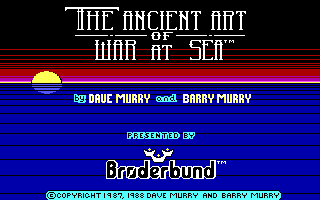
Visually, the game catered to the hardware of 1987, featuring support for EGA 16-color graphics alongside CGA and Hercules mono display modes, while audio came entirely through the standard internal PC speaker. When broadsides fire, the speaker clicks and sputters to simulate cannon fire, a crude setup compared to later sound card developments, but recognizable to anyone who played MS-DOS titles at the time.
Decades after its original release, this entry in Evryware's trilogy works well as a focused slice of real-time strategy and tactics. The battle mechanics hit a solid middle ground: complex enough to force real tactical decisions about wind and broadsides, but snappy enough that battles resolve in minutes rather than hours. While wrestling with wind vectors and coastal hazards takes practice, pulling off a successful boarding action against Blackbeard feels great.
You can play The Ancient Art of War at Sea free in your browser right now, with no hardware emulation setup required. Load up a quick custom skirmish in the editor or jump straight into the Spanish Armada scenario to see if you can outmaneuver the wind and take down your first enemy flagship tonight.
In The Ancient Art of War at Sea, Dave and Barry Murry brought 18th-century naval tactics to life on a strategic map where a single bad gust of wind could wreck your flagship long before the cannons fired.
Launching The Ancient Art of War at Sea drops you straight onto a strategic chart with tiny ships creeping across the open ocean under dynamic wind conditions. Designed by brothers Dave and Barry Murry at Evryware and published by Broderbund, this sequel expands on their 1984 land-based wargame by introducing naval movement mechanics, shoals, and broadside combat. You control a fleet composed of fast Frigates, heavy Ships-of-the-Line, and massive Flagships. You cannot build replacements, so keeping your vessels repaired at friendly ports or capturing enemy ships via boarding actions is the only way to sustain your fleet.
The strategic map runs in real time, though you can adjust the simulation speed whenever managing multiple squadrons gets chaotic. When two opposing fleets intersect, the view zooms into a tactical screen where you direct individual ships. Positioning matters completely: gaining the weather gauge puts the wind at your back, letting your Frigates outmaneuver slower vessels to rake their sterns. If your ship runs aground on shallow reefs or gets caught in dangerous rough seas, you can watch your hull integrity crumble without the enemy firing a single shot.

Instead of abstract difficulty settings, the game pits you against six distinct AI opponents who dictate how the enemy plays. You can square off against historical figures like Lord Horatio Nelson, John Paul Jones, Maarten Tromp, Blackbeard, and the Duke of Medina Sidonia, alongside the fictitious commander Thor Foote. Each AI commander favors specific tactics, whether that means Blackbeard launching constant boarding parties or Nelson hunting down your flagship without letting up. The original package shipped in a distinctive box featuring Fitz Henry Lane's 1815 painting of the USS President fighting a British squadron, earning industry recognition including CODiE Awards for both its packaging and action-strategy design.
Beyond the built-in historical scenarios like the Spanish Armada or Trafalgar, the game includes a robust scenario builder called the Game Generator. This editor lets you draft custom maps, place shoals, assign ports, and construct original fleet compositions for bespoke naval campaigns. The included scenarios even dip into what-if history with encounters like tracking down a phantom German battleship in the Atlantic, offering plenty of reasons to mess around with custom map parameters.
For all its tactical depth, navigating the environment remains the biggest point of friction for modern players. The navigation parameters and ship damage rules in shallow water can feel mercilessly unforgiving. A slight miscalculation on the tactical grid can trap your flagship on a shoal, leaving it completely exposed to enemy broadsides while your crew struggles to turn into the wind. If you misjudge the wind direction while pursuing a smaller vessel, you will watch your massive 130-gun flagship grind to a halt while smaller Frigates dance around your perimeter.

Visually, the game catered to the hardware of 1987, featuring support for EGA 16-color graphics alongside CGA and Hercules mono display modes, while audio came entirely through the standard internal PC speaker. When broadsides fire, the speaker clicks and sputters to simulate cannon fire, a crude setup compared to later sound card developments, but recognizable to anyone who played MS-DOS titles at the time.
Decades after its original release, this entry in Evryware's trilogy works well as a focused slice of real-time strategy and tactics. The battle mechanics hit a solid middle ground: complex enough to force real tactical decisions about wind and broadsides, but snappy enough that battles resolve in minutes rather than hours. While wrestling with wind vectors and coastal hazards takes practice, pulling off a successful boarding action against Blackbeard feels great.
You can play The Ancient Art of War at Sea free in your browser right now, with no hardware emulation setup required. Load up a quick custom skirmish in the editor or jump straight into the Spanish Armada scenario to see if you can outmaneuver the wind and take down your first enemy flagship tonight.
How The Ancient Art of War at Sea is played — the keys the game listens to, grouped by what they do.
Highlighted keys are mapped — hover or tap one to see what it does.
Movement and command controls are based on menu selections and directional map navigation. Custom campaign creation involves typing text.
The on-screen keyboard and gamepad mapping the browser player uses on a phone, a tablet or a controller, as opposed to the real keys above. $PRO members make their own in the player and share them here; anyone can pick one to play with.
Cheat codes, console commands and memory pokes for The Ancient Art of War at Sea — each one verified and attributed.
Sign in to submitHow The Ancient Art of War at Sea is played — the keys the game listens to, grouped by what they do.
Highlighted keys are mapped — hover or tap one to see what it does.
Movement and command controls are based on menu selections and directional map navigation. Custom campaign creation involves typing text.
The on-screen keyboard and gamepad mapping the browser player uses on a phone, a tablet or a controller, as opposed to the real keys above. $PRO members make their own in the player and share them here; anyone can pick one to play with.
Cheat codes, console commands and memory pokes for The Ancient Art of War at Sea — each one verified and attributed.
Sign in to submit