
In Mixed-Up Fairy Tales, Sierra On-Line took their famous adventure game engine and stripped out every way to die, handing kids a friendly dragon and five scrambled bedtime stories to patch back together.
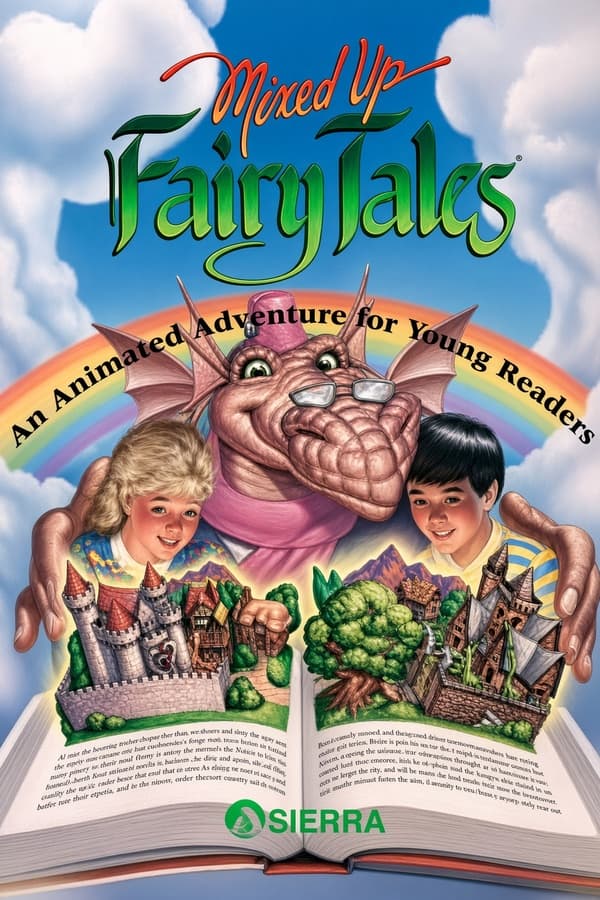
You begin by picking one of six children, giving them a name, and watching a dragon named Bookwyrm sweep you away to the land of make-believe. A troll named Bookend has stolen key items from five classic stories, leaving famous characters stranded across a 4x4 grid of screens. Designed by Lori Ann Cole, this 1991 title served as a direct follow-up to Mixed-Up Mother Goose, taking the core structure of fetching lost objects and adapting it into a simple point-and-click adventure game.
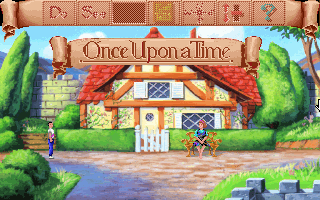
Unlike Sierra's standard line of Sierra On-Line, Inc. releases, you do not need to type commands or navigate a deep icon bar. The entire interface is reduced to just two basic buttons: "Do" and "See". You click on an item on the ground to pick it up, or click on a character to interact with them. There are no dead ends, no monster attacks, and no unexpected deaths to reset your progress.
The goal in Mixed-Up Fairy Tales is straightforward: identify which story needs help, locate its missing elements across the map, and bring them back to where they belong. The five fables scattered across the countryside are Cinderella, Beauty and the Beast, The Bremen Town Musicians, Jack and the Beanstalk, and Snow White. Each tale requires a specific sequence of items to complete.
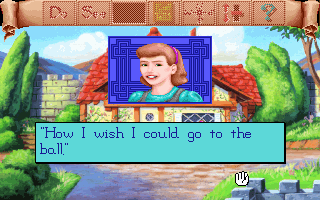
For Cinderella, you must retrieve her glass slipper and a pumpkin to set up the ball. Jack needs his magic beans and an axe so he can deal with the beanstalk, while Snow White requires help finding the house that belongs to the seven dwarves. You can only carry one inventory item at a time, so playing efficiently means remembering where you saw an item resting on a screen two rows over.

While the simplified mouse interface earned praise in period reviews like Compute! magazine, the actual map layout introduces the game's biggest flaw. The 4x4 grid contains several blank filler screens that exist purely to pad out the distance between story locations. Because there is no fast-travel or warp system, you spend a lot of time watching your child character slowly walk across featureless fields just to swap one inventory object for another.
When it was sold in stores, the box included a physical fairy tale coloring book and crayons to keep children entertained off-screen. On the technical side, the game ran on Sierra's SCI engine, featuring clean VGA graphics and classical music tracks arranged from composers like Bach and Mozart by musical director Mark Seibert. Back in 1991, players running this on an MS-DOS machine needed around 535K of free conventional RAM just to launch it, which often meant tweaking system boot files before the dragon would appear on screen.
As an educational gateway for younger gamers, the design remains surprisingly gentle, though modern kids who cannot read yet will still need an adult to sit beside them and narrate the dialogue text. The automatic save system names save files after your chosen character, making it easy to pick up a story midway through without worrying about managing files manually.
If you want to try this Sierra On-Line, Inc. project without wrestling with conventional memory allocation or old floppy disk images, you can play Mixed-Up Fairy Tales online directly through your web browser. Running the MS-DOS game online gives you immediate access to the full audio score and VGA visuals, letting you wander the grid and hand Jack his magic beans with zero setup required.
In Mixed-Up Fairy Tales, Sierra On-Line took their famous adventure game engine and stripped out every way to die, handing kids a friendly dragon and five scrambled bedtime stories to patch back together.
You begin by picking one of six children, giving them a name, and watching a dragon named Bookwyrm sweep you away to the land of make-believe. A troll named Bookend has stolen key items from five classic stories, leaving famous characters stranded across a 4x4 grid of screens. Designed by Lori Ann Cole, this 1991 title served as a direct follow-up to Mixed-Up Mother Goose, taking the core structure of fetching lost objects and adapting it into a simple point-and-click adventure game.
Unlike Sierra's standard line of Sierra On-Line, Inc. releases, you do not need to type commands or navigate a deep icon bar. The entire interface is reduced to just two basic buttons: "Do" and "See". You click on an item on the ground to pick it up, or click on a character to interact with them. There are no dead ends, no monster attacks, and no unexpected deaths to reset your progress.

The goal in Mixed-Up Fairy Tales is straightforward: identify which story needs help, locate its missing elements across the map, and bring them back to where they belong. The five fables scattered across the countryside are Cinderella, Beauty and the Beast, The Bremen Town Musicians, Jack and the Beanstalk, and Snow White. Each tale requires a specific sequence of items to complete.
For Cinderella, you must retrieve her glass slipper and a pumpkin to set up the ball. Jack needs his magic beans and an axe so he can deal with the beanstalk, while Snow White requires help finding the house that belongs to the seven dwarves. You can only carry one inventory item at a time, so playing efficiently means remembering where you saw an item resting on a screen two rows over.

While the simplified mouse interface earned praise in period reviews like Compute! magazine, the actual map layout introduces the game's biggest flaw. The 4x4 grid contains several blank filler screens that exist purely to pad out the distance between story locations. Because there is no fast-travel or warp system, you spend a lot of time watching your child character slowly walk across featureless fields just to swap one inventory object for another.
When it was sold in stores, the box included a physical fairy tale coloring book and crayons to keep children entertained off-screen. On the technical side, the game ran on Sierra's SCI engine, featuring clean VGA graphics and classical music tracks arranged from composers like Bach and Mozart by musical director Mark Seibert. Back in 1991, players running this on an MS-DOS machine needed around 535K of free conventional RAM just to launch it, which often meant tweaking system boot files before the dragon would appear on screen.

As an educational gateway for younger gamers, the design remains surprisingly gentle, though modern kids who cannot read yet will still need an adult to sit beside them and narrate the dialogue text. The automatic save system names save files after your chosen character, making it easy to pick up a story midway through without worrying about managing files manually.
If you want to try this Sierra On-Line, Inc. project without wrestling with conventional memory allocation or old floppy disk images, you can play Mixed-Up Fairy Tales online directly through your web browser. Running the MS-DOS game online gives you immediate access to the full audio score and VGA visuals, letting you wander the grid and hand Jack his magic beans with zero setup required.
How Mixed-Up Fairy Tales is played — the keys the game listens to, grouped by what they do.
Highlighted keys are mapped — hover or tap one to see what it does.
The game relies primarily on mouse control with optional keyboard arrow support for movement and interaction.
The on-screen keyboard and gamepad mapping the browser player uses on a phone, a tablet or a controller, as opposed to the real keys above. $PRO members make their own in the player and share them here; anyone can pick one to play with.
Cheat codes, console commands and memory pokes for Mixed-Up Fairy Tales — each one verified and attributed.
Sign in to submitHow Mixed-Up Fairy Tales is played — the keys the game listens to, grouped by what they do.
Highlighted keys are mapped — hover or tap one to see what it does.
The game relies primarily on mouse control with optional keyboard arrow support for movement and interaction.
The on-screen keyboard and gamepad mapping the browser player uses on a phone, a tablet or a controller, as opposed to the real keys above. $PRO members make their own in the player and share them here; anyone can pick one to play with.
Cheat codes, console commands and memory pokes for Mixed-Up Fairy Tales — each one verified and attributed.
Sign in to submit