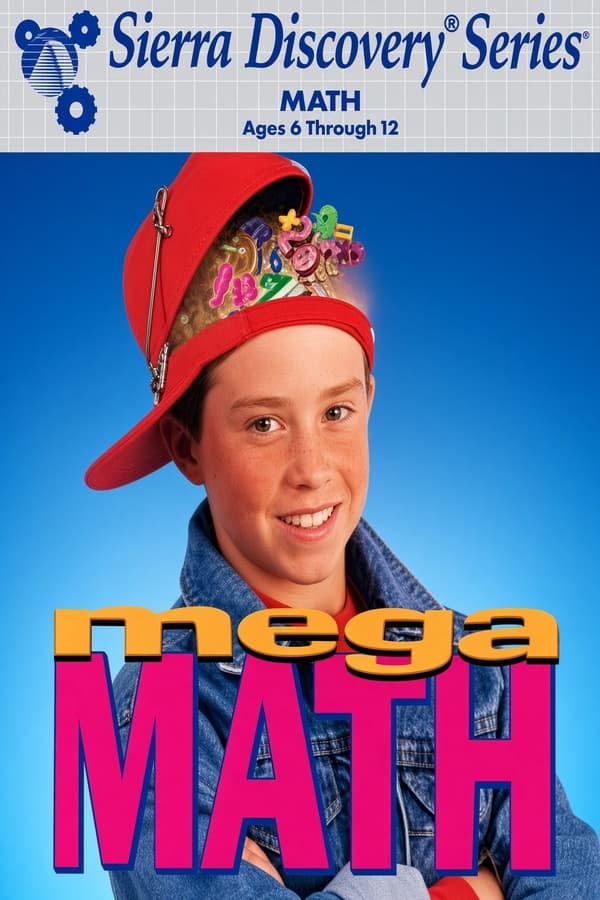
Mega Math
aka Turbo Learning: Mega Math
In 1993, Sierra published Mega Math, an educational title featuring two upbeat alien hosts named Quarky and Quaysoo who ask players to blast moving numbers with a laser to solve basic algebra equations. Guided by Dr. Krista, it was the brief follow-up to Turbo Science before the series quietly ended.
Shooting equations with Quarky and Quaysoo
The game wastes no time placing you into its classroom setting. After creating a student profile on the sign-in screen, Dr. Krista introduces the curriculum, which focuses entirely on standard arithmetic and early algebraic concepts. Rather than delivering flat textbook exercises, the software delegates the work to Quarky and Quaysoo, a pair of colorful extraterrestrials who turn numerical drills into arcade challenges.
The main effort goes toward solving equations built around fundamental order of operations rules. Addition, subtraction, multiplication, and division are all represented across varying skill tiers, ensuring players work through basic arithmetic before attempting complex multi-step problems. The primary action mode presents a side-scrolling view where numerical aliens float across the screen, and you must aim a targeting laser to blast the exact value needed to solve the active equation.
This approach gives educational gaming a direct, hands-on mechanic. Instead of clicking multiple choice buttons, you track target speeds, adjust your aim, and react to fast-moving targets while keeping the required solution fresh in your head.
Why Mega Math scaled back the Turbo Science formula
Developer Jeff Tunnell Productions, formed by the co-founder of Dynamix, created this project for publisher Sierra On-Line, Inc. during a competitive era for home computer software. Its predecessor, Turbo Science, offered players a broad world filled with interactive experiments across multiple scientific disciplines. By contrast, this second release reduced the scope dramatically to focus on a singular subject.
Instead of exploring large interactive environments, players spend their time cycling through a smaller, dedicated structure. The game concentrates its entire experience into three distinct mini-games paired with formal assessment stages:
- Arcade target drills: Blast numerical targets in side-scrolling levels to fulfill pending arithmetic equations.
- Symbol assembly puzzles: Arrange floating digits and mathematical operators into correct order of operations sequences.
- Progress testing modules: Complete periodic quizzes administered by Dr. Krista to gain access to higher difficulty tiers.
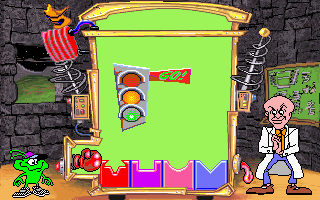
What going through the drills actually feels like
When you jump into this 1993 release, the core loop becomes apparent within five minutes. You choose a challenge, hit the targets or match symbols to clear the round, and then submit to a progress check from Dr. Krista. Quarky and Quaysoo offer comedic animations between rounds, providing brief pauses before you head straight back into another set of equations.
For players seeking a genuine arcade thrill, the shooting mechanics feel somewhat plain. Hitting a drifting alien instantly satisfies the math prompt without dramatic sound effects or complex physics, and making a mistake simply forces you to calculate again. The low penalty for wrong answers keeps stress levels manageable for younger students, though it removes the tension that usually makes arcade shooters exciting.
The difficulty curve scales cleanly as you pass Dr. Krista’s tests. Simple single-digit addition quickly gives way to multi-step equations requiring strict attention to parenthetical math rules, giving the later levels genuine substance for students mastering intermediate math skills.
Technical issues and the limit of three mini-games
Retrospective players often note that the narrow focus creates an obvious problem over longer play sessions. Because there are only three mini-games available, the variety wears thin quickly. Once a player masters the targeting speed in the side-scrolling level and understands the symbol puzzle format, the title has shown its entire mechanical inventory, relying purely on harder numbers to maintain interest.
Running the Mega Math MS-DOS game today can also present a few minor interface hurdles. Navigating the original player sign-in menus requires precise inputs, and mouse tracking inside DOS emulation software occasionally feels floaty when attempting to hit fast-moving targets near the edges of the display area. Tester John Wolf and the quality assurance group ensured the underlying math calculations and scoring triggers were rock solid, but the static user interface elements betray its early nineties PC origins.
Ready to play Mega Math free in your browser right now
Sierra split the difference here between an arcade game and a drill sergeant, pairing simple keyboard controls with rapid-fire arithmetic problems. It loses the open-ended wandering of the original game, but the math lessons come fast, the alien sidekicks react quickly to wrong answers, and the whole thing runs smoothly in standard VGA.
You can play Mega Math online free in your browser today without dealing with mounting procedures or custom disk images. Everything is loaded and ready right here, letting you test your arithmetic speed against Quarky, Quaysoo, and Dr. Krista immediately.