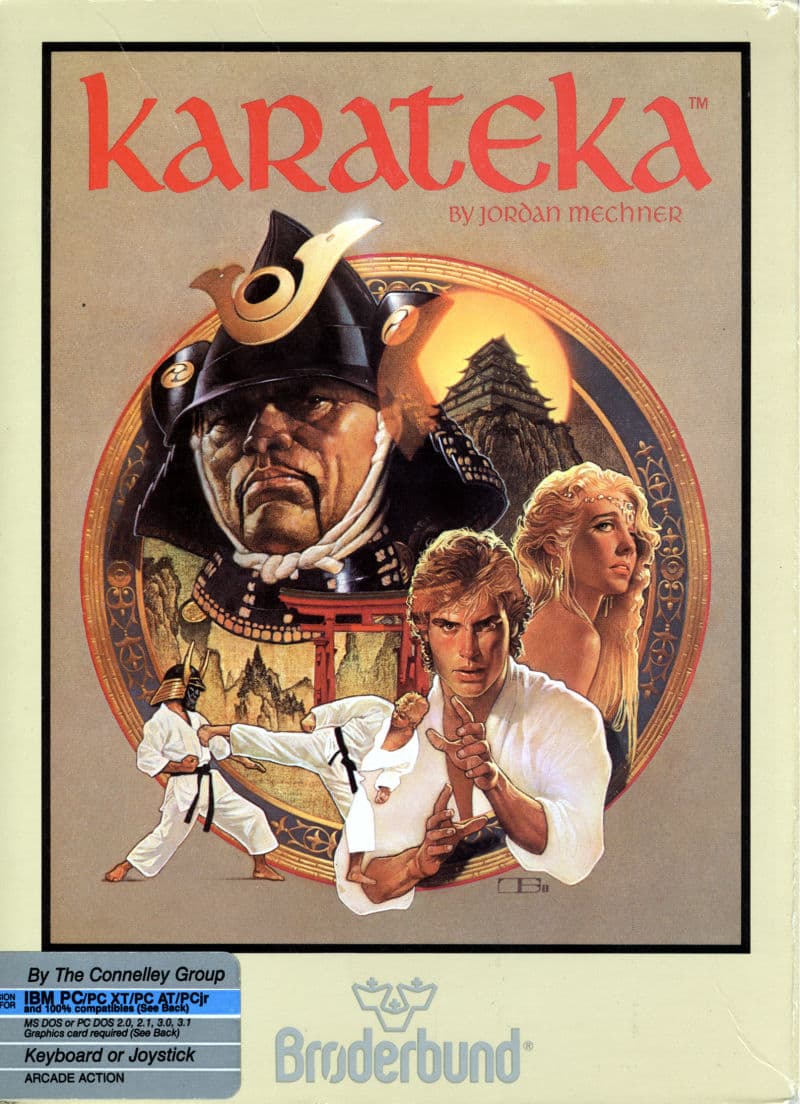
Karateka hinges on a single brutal trick: if you take a step forward without raising your combat stance first, the very first palace guard will kill you in one hit.
Every encounter in Karateka is a strict game of distance and spacing. Created by Jordan Mechner and brought to MS-DOS by The Connelley Group, the game discards the free-roaming chaos of arcade brawlers for a tight, cinematic tug-of-war. You step into the fortress of the warlord Akuma to rescue Princess Mariko, moving strictly from left to right through courtyards and screen-wiping corridors. Pressing the spacebar toggles your character between a normal walking posture and a fighting stance. If an enemy catches you walking, a single punch ends your run instantly, forcing you right back to the opening screen of the game.
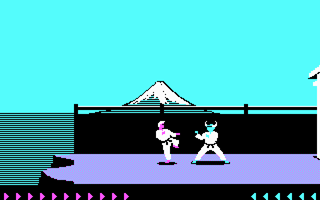
Once both fighters stand in their combat stances, combat turns into a battle of high, medium, and low strikes paired with quick retreats. Each character has a health meter at the bottom of the display that drains with every landed blow. Standing still allows your health to regenerate slowly, but idling gives your enemy time to recover as well. You cannot rely on button-mashing because mid-level guards block predictable patterns and hit back hard enough to wipe out half your bar. Victory relies on baiting an attack, retreating slightly, and landing a high kick the moment your opponent recovers.
The visual fluidity of this action game came from a process virtually unheard of on home computers at the time. Mechner traced animation frames directly over film footage of his karate instructor, drawing each frame by hand to capture real human weight and momentum. The techniques he refined here directly laid the groundwork for his work on Prince of Persia years later. The presentation draws heavily from Japanese Ukiyo-e woodblock prints, silent cinema, and Kurosawa films, using dramatic screen wipes between areas instead of simple hard cuts.
That artistic ambition created a stark contrast with the computer hardware of 1986. While the original Apple II release featured a soundtrack written by Mechner's father Francis, PC owners played this port through the sharp, bleeping tones of the built-in PC speaker. Hearing Akuma's theme chirp through internal computer speakers while watching rotoscoped martial artists duel gave the DOS port a very specific, minimalist feel. It was cinematic in design, even when constrained by the technology of the day.
The design decisions that made the original release famous are also the ones that alienate modern players. When Compute! reviewed the game in 1985, they praised its scale but highlighted the central frustration: dying means restarting the entire game from the fortress entrance. There are no save files, no passwords, no checkpoints, and no extra lives. A single mistake against Akuma's trained attack hawk or a late-game palace guard wipes out twenty minutes of careful progress.
The control mapping on PC also feels notoriously stiff to anyone accustomed to modern fluid input. Key presses must be timed deliberately to match the full animation cycles of punches and kicks. Attempting to spam attacks locks your character into animation delays, leaving your midsection completely open to counter-strikes. Managing enemy stamina becomes a delicate routine: you have to push guards backward into the right edge of the screen without overextending your own health pool.
Then there is the final, infamous trap waiting inside Princess Mariko's cell. After defeating Akuma himself in a demanding boss fight, you finally reach the kidnapped princess. If you running-jump or walk toward her while still holding your combat stance, Mariko instantly knocks you out with a single kick, presenting you with a full game-over screen at the very end of your journey. To win, you have to drop your stance and approach her peacefully, a trick that caught thousands of players off-guard.
You can play Karateka online right now to see what Brøderbund Software, Inc. published back in 1986. It shows exactly how early developers pushed smooth physics and cinematic storytelling out of limited hardware.
You can launch this classic hit free in your browser with no extra software to set up. Just remember the one golden rule every retro fan learns the hard way: assume your fighting stance before you take a single step forward, and drop it completely before you reach the princess.
Karateka hinges on a single brutal trick: if you take a step forward without raising your combat stance first, the very first palace guard will kill you in one hit.
Every encounter in Karateka is a strict game of distance and spacing. Created by Jordan Mechner and brought to MS-DOS by The Connelley Group, the game discards the free-roaming chaos of arcade brawlers for a tight, cinematic tug-of-war. You step into the fortress of the warlord Akuma to rescue Princess Mariko, moving strictly from left to right through courtyards and screen-wiping corridors. Pressing the spacebar toggles your character between a normal walking posture and a fighting stance. If an enemy catches you walking, a single punch ends your run instantly, forcing you right back to the opening screen of the game.

Once both fighters stand in their combat stances, combat turns into a battle of high, medium, and low strikes paired with quick retreats. Each character has a health meter at the bottom of the display that drains with every landed blow. Standing still allows your health to regenerate slowly, but idling gives your enemy time to recover as well. You cannot rely on button-mashing because mid-level guards block predictable patterns and hit back hard enough to wipe out half your bar. Victory relies on baiting an attack, retreating slightly, and landing a high kick the moment your opponent recovers.
The visual fluidity of this action game came from a process virtually unheard of on home computers at the time. Mechner traced animation frames directly over film footage of his karate instructor, drawing each frame by hand to capture real human weight and momentum. The techniques he refined here directly laid the groundwork for his work on Prince of Persia years later. The presentation draws heavily from Japanese Ukiyo-e woodblock prints, silent cinema, and Kurosawa films, using dramatic screen wipes between areas instead of simple hard cuts.
That artistic ambition created a stark contrast with the computer hardware of 1986. While the original Apple II release featured a soundtrack written by Mechner's father Francis, PC owners played this port through the sharp, bleeping tones of the built-in PC speaker. Hearing Akuma's theme chirp through internal computer speakers while watching rotoscoped martial artists duel gave the DOS port a very specific, minimalist feel. It was cinematic in design, even when constrained by the technology of the day.
The design decisions that made the original release famous are also the ones that alienate modern players. When Compute! reviewed the game in 1985, they praised its scale but highlighted the central frustration: dying means restarting the entire game from the fortress entrance. There are no save files, no passwords, no checkpoints, and no extra lives. A single mistake against Akuma's trained attack hawk or a late-game palace guard wipes out twenty minutes of careful progress.

The control mapping on PC also feels notoriously stiff to anyone accustomed to modern fluid input. Key presses must be timed deliberately to match the full animation cycles of punches and kicks. Attempting to spam attacks locks your character into animation delays, leaving your midsection completely open to counter-strikes. Managing enemy stamina becomes a delicate routine: you have to push guards backward into the right edge of the screen without overextending your own health pool.
Then there is the final, infamous trap waiting inside Princess Mariko's cell. After defeating Akuma himself in a demanding boss fight, you finally reach the kidnapped princess. If you running-jump or walk toward her while still holding your combat stance, Mariko instantly knocks you out with a single kick, presenting you with a full game-over screen at the very end of your journey. To win, you have to drop your stance and approach her peacefully, a trick that caught thousands of players off-guard.
You can play Karateka online right now to see what Brøderbund Software, Inc. published back in 1986. It shows exactly how early developers pushed smooth physics and cinematic storytelling out of limited hardware.
You can launch this classic hit free in your browser with no extra software to set up. Just remember the one golden rule every retro fan learns the hard way: assume your fighting stance before you take a single step forward, and drop it completely before you reach the princess.
How Karateka is played — the keys the game listens to, grouped by what they do.
Highlighted keys are mapped — hover or tap one to see what it does.
The on-screen keyboard and gamepad mapping the browser player uses on a phone, a tablet or a controller, as opposed to the real keys above. $PRO members make their own in the player and share them here; anyone can pick one to play with.
Cheat codes, console commands and memory pokes for Karateka — each one verified and attributed.
Sign in to submitHow Karateka is played — the keys the game listens to, grouped by what they do.
Highlighted keys are mapped — hover or tap one to see what it does.
The on-screen keyboard and gamepad mapping the browser player uses on a phone, a tablet or a controller, as opposed to the real keys above. $PRO members make their own in the player and share them here; anyone can pick one to play with.
Cheat codes, console commands and memory pokes for Karateka — each one verified and attributed.
Sign in to submit