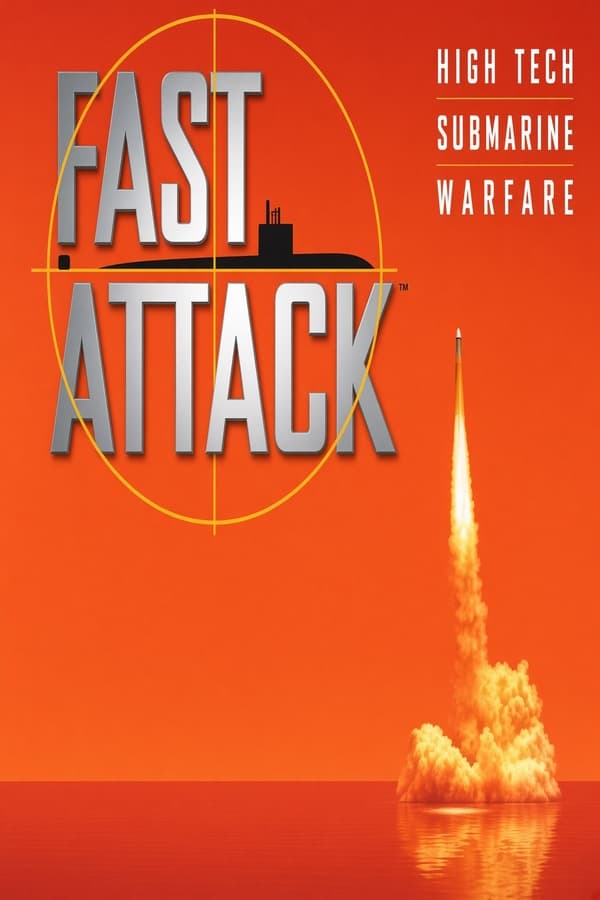
aka Fast Attack
Playing Fast Attack: High Tech Submarine Warfare means taking command of a Los Angeles-class nuclear attack submarine where success depends entirely on reading raw sensor data rather than dodging enemy fire in real time.
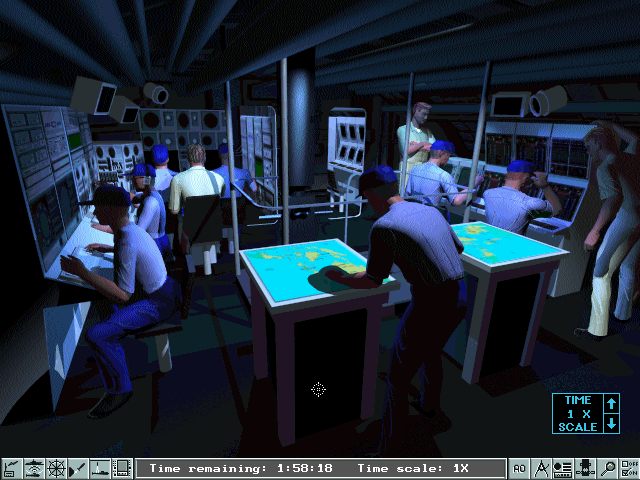
Most naval sims of the mid-nineties leaned heavily into flashy 3D exterior views, but development team Software Sorcery chose a different route. Headed by former US Navy Commander James R. Jones III and staffed by former naval officers, the studio built a simulation where you spend your time inside the command center switching between functional stations. You move between the Helm, the Area of Operations map, the Plot Table, the WLR-9 evasion system, Radio, Periscope, Fire Control, and the Launch Console managing vertical launch tubes.
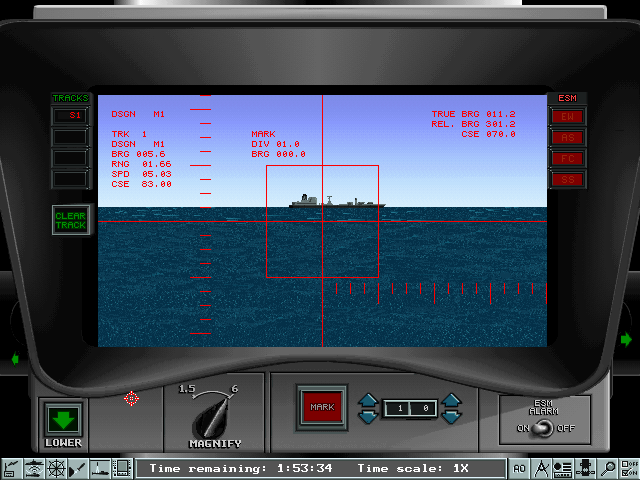
Instead of watching smooth polygon dogfights, you track contacts using a waterfall display on the sonar screen. Working out whether a quiet contact on your array is an Iranian fast Guided Missile Frigate, a civilian freighter, or a surface-to-surface threat requires genuine patience. The game rewards you for reading the water correctly before you ever load a tube, treating sub warfare as a high-stakes chess match played through screens and audio cues.
When you launch a mission in Sierra On-Line, Inc.'s 1996 release, you step into real-world theaters including the Sea of Japan, the Mediterranean, and the Persian Gulf. Mission objectives range far beyond basic search-and-destroy runs, throwing you into mine hunting, convoy escort, sub hunting, and land strikes. One early mission sends you to counter an Iranian fast missile boat attempt to blockade the Persian Gulf, forcing you to pick off agile surface threats without giving away your location to enemy attack subs lurking nearby.
Loading out your vessel demands picking the right tool for the objective:
The best part is the authentic crew audio. Voice chatter echoes through the command center with crisp naval phrasing like "conn helm aye," mirroring the tension of movies like Crimson Tide. Hearing your sonar technician report a distant launch puts you right on edge, while stylized cutscene videos show your Harpoon missiles breaking the ocean surface and igniting their boosters.
For all its depth, the game suffers from severe engineering flaws that hurt the experience. The main offender is a hard real-time cap of two hours per assignment. Submarine warfare relies on slow positioning and quiet tracking, yet this strict timer forces you to rush your approach, driving your boat fast and loud straight into enemy minefields or torpedo ambushes just to reach the target area before time expires.
The code itself can be uncooperative. The fire control station occasionally exhibits erratic behavior, locking up targeting solution calculations right when an enemy fast attack craft closes range. Worse, using time compression to skip long ocean transits routinely crashes the executable straight back to the command prompt. When Software Sorcery dissolved shortly after release, fans were left without patches for these crashes, and two planned follow-ups - Akula: Red Hunter and Greyhound of the Seas - were canceled entirely.
If you enjoy hardcore late-nineties tactical simulations like Aegis: Guardian of the Fleet or Jutland, this boat is still worth taking out of port. The 3D exterior visuals look blocky and basic by today's standards, and the low-bit audio streams can sound harsh through modern speakers, but the core command loop remains surprisingly engrossing once you understand how the plot table interacts with sonar passive tracking.
You can play 1996's Fast Attack: High Tech Submarine Warfare online free in your browser right now, running the complete MS-DOS sim without downloading extra system files or tweaking DOS config files. When your first assignment loads, head straight to the sonar station, flip passive tracking on, and listen carefully to the water fall display before touching the engine controls. Mastering your sub's acoustic signature early is the only way you will survive your first tactical engagement.
Playing Fast Attack: High Tech Submarine Warfare means taking command of a Los Angeles-class nuclear attack submarine where success depends entirely on reading raw sensor data rather than dodging enemy fire in real time.
Most naval sims of the mid-nineties leaned heavily into flashy 3D exterior views, but development team Software Sorcery chose a different route. Headed by former US Navy Commander James R. Jones III and staffed by former naval officers, the studio built a simulation where you spend your time inside the command center switching between functional stations. You move between the Helm, the Area of Operations map, the Plot Table, the WLR-9 evasion system, Radio, Periscope, Fire Control, and the Launch Console managing vertical launch tubes.
Instead of watching smooth polygon dogfights, you track contacts using a waterfall display on the sonar screen. Working out whether a quiet contact on your array is an Iranian fast Guided Missile Frigate, a civilian freighter, or a surface-to-surface threat requires genuine patience. The game rewards you for reading the water correctly before you ever load a tube, treating sub warfare as a high-stakes chess match played through screens and audio cues.

When you launch a mission in Sierra On-Line, Inc.'s 1996 release, you step into real-world theaters including the Sea of Japan, the Mediterranean, and the Persian Gulf. Mission objectives range far beyond basic search-and-destroy runs, throwing you into mine hunting, convoy escort, sub hunting, and land strikes. One early mission sends you to counter an Iranian fast missile boat attempt to blockade the Persian Gulf, forcing you to pick off agile surface threats without giving away your location to enemy attack subs lurking nearby.
Loading out your vessel demands picking the right tool for the objective:
The best part is the authentic crew audio. Voice chatter echoes through the command center with crisp naval phrasing like "conn helm aye," mirroring the tension of movies like Crimson Tide. Hearing your sonar technician report a distant launch puts you right on edge, while stylized cutscene videos show your Harpoon missiles breaking the ocean surface and igniting their boosters.

For all its depth, the game suffers from severe engineering flaws that hurt the experience. The main offender is a hard real-time cap of two hours per assignment. Submarine warfare relies on slow positioning and quiet tracking, yet this strict timer forces you to rush your approach, driving your boat fast and loud straight into enemy minefields or torpedo ambushes just to reach the target area before time expires.
The code itself can be uncooperative. The fire control station occasionally exhibits erratic behavior, locking up targeting solution calculations right when an enemy fast attack craft closes range. Worse, using time compression to skip long ocean transits routinely crashes the executable straight back to the command prompt. When Software Sorcery dissolved shortly after release, fans were left without patches for these crashes, and two planned follow-ups - Akula: Red Hunter and Greyhound of the Seas - were canceled entirely.

If you enjoy hardcore late-nineties tactical simulations like Aegis: Guardian of the Fleet or Jutland, this boat is still worth taking out of port. The 3D exterior visuals look blocky and basic by today's standards, and the low-bit audio streams can sound harsh through modern speakers, but the core command loop remains surprisingly engrossing once you understand how the plot table interacts with sonar passive tracking.
You can play 1996's Fast Attack: High Tech Submarine Warfare online free in your browser right now, running the complete MS-DOS sim without downloading extra system files or tweaking DOS config files. When your first assignment loads, head straight to the sonar station, flip passive tracking on, and listen carefully to the water fall display before touching the engine controls. Mastering your sub's acoustic signature early is the only way you will survive your first tactical engagement.
How Fast Attack: High Tech Submarine Warfare is played — the keys the game listens to, grouped by what they do.
Highlighted keys are mapped — hover or tap one to see what it does.
Keyboard shortcuts could not be located in available reference material; station controls rely primarily on mouse interaction.
The on-screen keyboard and gamepad mapping the browser player uses on a phone, a tablet or a controller, as opposed to the real keys above. $PRO members make their own in the player and share them here; anyone can pick one to play with.
Cheat codes, console commands and memory pokes for Fast Attack: High Tech Submarine Warfare — each one verified and attributed.
Sign in to submitHow Fast Attack: High Tech Submarine Warfare is played — the keys the game listens to, grouped by what they do.
Highlighted keys are mapped — hover or tap one to see what it does.
Keyboard shortcuts could not be located in available reference material; station controls rely primarily on mouse interaction.
The on-screen keyboard and gamepad mapping the browser player uses on a phone, a tablet or a controller, as opposed to the real keys above. $PRO members make their own in the player and share them here; anyone can pick one to play with.
Cheat codes, console commands and memory pokes for Fast Attack: High Tech Submarine Warfare — each one verified and attributed.
Sign in to submit