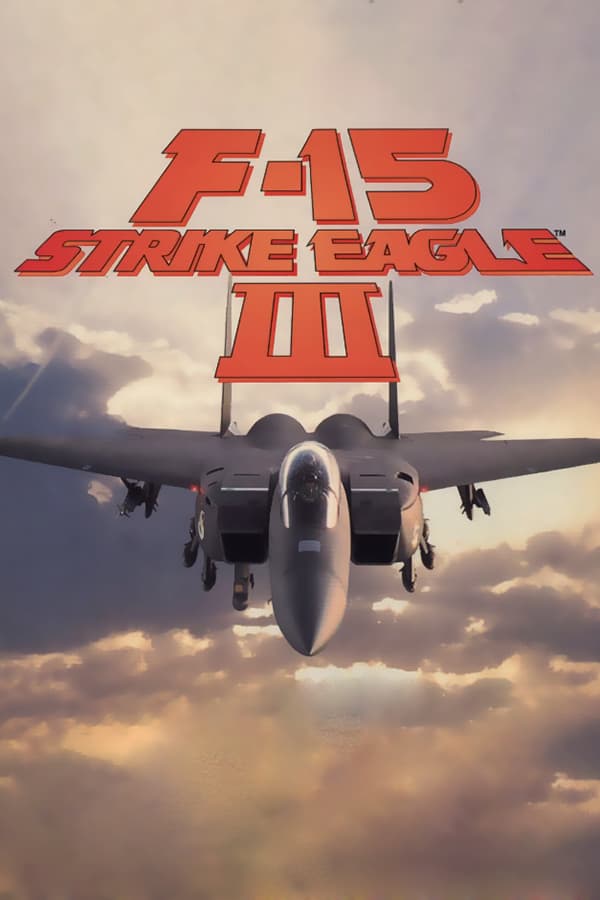
Flight simulator fans who loaded up F-15 Strike Eagle III upon its 1992 release were greeted by unmatched cockpit complexity and detailed terrain, provided their computers could handle the frame rate. Designed by Andy Hollis, this ambitious release pushed MS-DOS machines straight to their limits while delivering true co-op multiplayer inside a single strike fighter.
When you start a campaign, the game drops you right into one of three distinct combat zones: Operation Desert Storm in Iraq, the Korean Peninsula, or the Panama Canal Zone. The terrain mapping was a massive step forward for MPS Labs, featuring actual landmarks drawn from real map data. Flying over Baghdad, you can spot the Iraqi Presidential Palace, the Ministry of Defense, and the major bridges spanning the Euphrates River. Navigating the Korean DMZ or tracking targets between Seoul and Pyongyang demands constant scanning of your multi-function displays.
Your job as a pilot is rarely a simple dogfight. Missions assign a primary ground target along with an optional secondary objective, forcing you to balance fuel consumption, air threats, and surface-to-air missile sites. You check in with AWACS for tactical updates, switch radar modes to paint terrain targets, and line up runs using laser-guided bombs, free-fall ordnance, air-to-ground missiles, Sidewinders, and the internal M61 Vulcan cannon. Getting low over the rooftops to evade radar while lining up a smart bomb run gets your knuckles white fast.
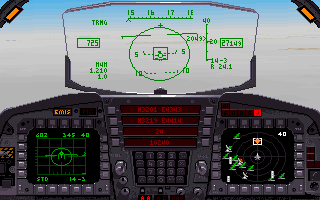
The flight model strikes a deliberate middle ground between hardcore switch-flipping and accessible action. You have to manage your engine thrust, monitor g-forces during hard turns, and deploy chaff or flares the second a radar lock warning wails in your headset. If you get sloppy with your pitch during a low-level bomb run, the terrain will claim you long before an enemy MiG-29 gets the chance.
The feature that set this title apart from almost every competitor was its dual-player flight mode over modem or direct serial link. Instead of merely flying as wingmen in separate planes, you and a friend could crew the exact same F-15E Strike Eagle. One player took the front seat as pilot to handle flying and flight control, while the second sat in the back as the Weapon Systems Officer, managing radar systems, defensive countermeasures, and target acquisition.
Coordinating an attack over a noisy 2400-baud phone line required real communication. While the pilot kept the jet stable low over enemy territory, the gunner locked onto targets and designated laser coordinates for smart bombs. When it worked, it felt like nothing else available in 1992. When the phone connection dropped halfway through a two-hour deep strike mission, it tested friendships in equal measure.
MicroProse skipped physical disk copy protection for this release, choosing a manual lookup system instead. Before heading to the flight line, the game asks you to identify a specific word from a given page, paragraph, and line of the printed manual in your chosen language. Getting the answer wrong does not crash the game: it demotes you to basic flight training, restricting your flight time to simple takeoffs and landings on a barren airfield until you get the manual back out.
Publisher MicroProse poured a development budget of $1.2 million into the project, directing significant engine work toward ground and sky rendering. The software engine introduced textured terrain mapping, sky gradients, and environmental atmospheric fog effects. On a standard 386 PC at launch, those graphics features exacted a heavy toll on performance. When Computer Gaming World reviewed the title in early 1993, reviewer Doug Fick famously titled his piece "The Eagle Has Landed... Slowly" because of how severely the frame rate chugged on typical consumer machines.
The sound hardware support was far more generous. The engine provided audio drivers for everything from the basic internal PC speaker and Covox Sound Master up to the Sound Blaster, Sound Blaster Pro, Ad Lib, Pro Audio Spectrum series, and the Roland MT-32. Hearing engine roars and radio chatter rendered through proper expansion hardware added immense atmosphere to long night sorties.
The tech built for this project did not go to waste after launch. MPS Labs adapted and refined the graphics engine for their later jet sim F-14 Fleet Defender, while lead designer Andy Hollis eventually carried these combat simulation concepts forward into his work on Jane's F-15. The core design framework established here became a foundation for an entire subgenre of military flight titles.
If you enjoy classic military simulation games, the level of mission depth and geographic accuracy here still offers plenty to sink your teeth into. The flight physics feel weighty, the cockpit instrumentation rewards careful planning, and targeting fortified structures in downtown Baghdad carries genuine tactical weight. The main element that shows its age is the raw visual clarity: distant low-resolution terrain textures can make ground targets hard to spot visually without relying heavily on your radar displays.
You can play F-15 Strike Eagle III online right now, completely free in your browser without installing files or tweaking memory settings. If you want to sample this piece of flight sim history, launch into the Desert Storm theater, load up a full rack of laser-guided munitions, and see how well you handle a low-altitude strike against heavily defended airfields.
Flight simulator fans who loaded up F-15 Strike Eagle III upon its 1992 release were greeted by unmatched cockpit complexity and detailed terrain, provided their computers could handle the frame rate. Designed by Andy Hollis, this ambitious release pushed MS-DOS machines straight to their limits while delivering true co-op multiplayer inside a single strike fighter.
When you start a campaign, the game drops you right into one of three distinct combat zones: Operation Desert Storm in Iraq, the Korean Peninsula, or the Panama Canal Zone. The terrain mapping was a massive step forward for MPS Labs, featuring actual landmarks drawn from real map data. Flying over Baghdad, you can spot the Iraqi Presidential Palace, the Ministry of Defense, and the major bridges spanning the Euphrates River. Navigating the Korean DMZ or tracking targets between Seoul and Pyongyang demands constant scanning of your multi-function displays.
Your job as a pilot is rarely a simple dogfight. Missions assign a primary ground target along with an optional secondary objective, forcing you to balance fuel consumption, air threats, and surface-to-air missile sites. You check in with AWACS for tactical updates, switch radar modes to paint terrain targets, and line up runs using laser-guided bombs, free-fall ordnance, air-to-ground missiles, Sidewinders, and the internal M61 Vulcan cannon. Getting low over the rooftops to evade radar while lining up a smart bomb run gets your knuckles white fast.

The flight model strikes a deliberate middle ground between hardcore switch-flipping and accessible action. You have to manage your engine thrust, monitor g-forces during hard turns, and deploy chaff or flares the second a radar lock warning wails in your headset. If you get sloppy with your pitch during a low-level bomb run, the terrain will claim you long before an enemy MiG-29 gets the chance.
The feature that set this title apart from almost every competitor was its dual-player flight mode over modem or direct serial link. Instead of merely flying as wingmen in separate planes, you and a friend could crew the exact same F-15E Strike Eagle. One player took the front seat as pilot to handle flying and flight control, while the second sat in the back as the Weapon Systems Officer, managing radar systems, defensive countermeasures, and target acquisition.
Coordinating an attack over a noisy 2400-baud phone line required real communication. While the pilot kept the jet stable low over enemy territory, the gunner locked onto targets and designated laser coordinates for smart bombs. When it worked, it felt like nothing else available in 1992. When the phone connection dropped halfway through a two-hour deep strike mission, it tested friendships in equal measure.
MicroProse skipped physical disk copy protection for this release, choosing a manual lookup system instead. Before heading to the flight line, the game asks you to identify a specific word from a given page, paragraph, and line of the printed manual in your chosen language. Getting the answer wrong does not crash the game: it demotes you to basic flight training, restricting your flight time to simple takeoffs and landings on a barren airfield until you get the manual back out.
Publisher MicroProse poured a development budget of $1.2 million into the project, directing significant engine work toward ground and sky rendering. The software engine introduced textured terrain mapping, sky gradients, and environmental atmospheric fog effects. On a standard 386 PC at launch, those graphics features exacted a heavy toll on performance. When Computer Gaming World reviewed the title in early 1993, reviewer Doug Fick famously titled his piece "The Eagle Has Landed... Slowly" because of how severely the frame rate chugged on typical consumer machines.

The sound hardware support was far more generous. The engine provided audio drivers for everything from the basic internal PC speaker and Covox Sound Master up to the Sound Blaster, Sound Blaster Pro, Ad Lib, Pro Audio Spectrum series, and the Roland MT-32. Hearing engine roars and radio chatter rendered through proper expansion hardware added immense atmosphere to long night sorties.
The tech built for this project did not go to waste after launch. MPS Labs adapted and refined the graphics engine for their later jet sim F-14 Fleet Defender, while lead designer Andy Hollis eventually carried these combat simulation concepts forward into his work on Jane's F-15. The core design framework established here became a foundation for an entire subgenre of military flight titles.
If you enjoy classic military simulation games, the level of mission depth and geographic accuracy here still offers plenty to sink your teeth into. The flight physics feel weighty, the cockpit instrumentation rewards careful planning, and targeting fortified structures in downtown Baghdad carries genuine tactical weight. The main element that shows its age is the raw visual clarity: distant low-resolution terrain textures can make ground targets hard to spot visually without relying heavily on your radar displays.
You can play F-15 Strike Eagle III online right now, completely free in your browser without installing files or tweaking memory settings. If you want to sample this piece of flight sim history, launch into the Desert Storm theater, load up a full rack of laser-guided munitions, and see how well you handle a low-altitude strike against heavily defended airfields.
How F-15 Strike Eagle III is played — the keys the game listens to, grouped by what they do.
Highlighted keys are mapped — hover or tap one to see what it does.
Recalibrate the joystick in-game using Alt+J if directional controls drift.
The on-screen keyboard and gamepad mapping the browser player uses on a phone, a tablet or a controller, as opposed to the real keys above. $PRO members make their own in the player and share them here; anyone can pick one to play with.
Cheat codes, console commands and memory pokes for F-15 Strike Eagle III — each one verified and attributed.
Sign in to submitaka III הנשר התוקף
How F-15 Strike Eagle III is played — the keys the game listens to, grouped by what they do.
Highlighted keys are mapped — hover or tap one to see what it does.
Recalibrate the joystick in-game using Alt+J if directional controls drift.
The on-screen keyboard and gamepad mapping the browser player uses on a phone, a tablet or a controller, as opposed to the real keys above. $PRO members make their own in the player and share them here; anyone can pick one to play with.
Cheat codes, console commands and memory pokes for F-15 Strike Eagle III — each one verified and attributed.
Sign in to submit