
Everest: The Iceman's Apprentice
aka Everest: Iceman's Apprentice · Everest - The Iceman's Apprentice
Rate this game
- Played
- Rarely
Everest: The Iceman's Apprentice turns the lethal world of high-altitude mountaineering into a cold, calculated game of logbook management and supply lines.
High-altitude logistics made Everest: The Iceman's Apprentice a brutal strategy game
Most games from 1996 that took you outdoors handed you a gun or a platforming character, but designer Steve Estvanik took a very different path. Drawing directly from four trekking expeditions he led through Nepal's Khumbu region, Estvanik built Everest: The Iceman's Apprentice around the quiet, terrifying reality of mountain endurance. It isn't an action title where quick reflexes save your life; it is a strict managerial simulation game where a missing tank of oxygen or a poorly timed push past base camp means your team perishes in the snow.
Running in 640×480 resolution, the game trades low-polygon action for digitized high-resolution photographs of real peaks. You start by assembling a roster of climbers, balancing their individual strengths and weaknesses before setting foot on the mountain. Once on site, your job isn't to steer a character up a rock face, but to organize supply chains. You move team members between waypoints, set up intermediate camps, shuttle gear up from base camp, and carefully manage rest cycles to keep fatigue from killing your crew.
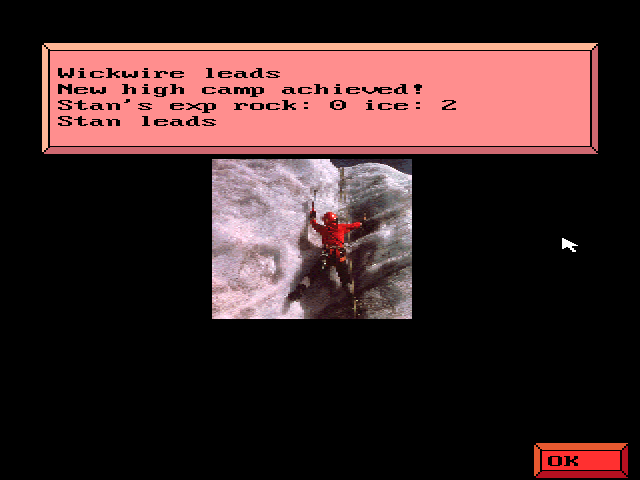
The arithmetic of survival at twenty thousand feet
The core mechanics put heavy emphasis on raw physical limits. Above twenty thousand feet, the atmosphere ceases to support human life gracefully, forcing every single climber on your team to carry supplemental oxygen at all times. If your supply runs out, or if you send an undernourished climber into a pitch during bad weather, their performance tanks immediately. The game constantly tracks hidden attributes like willpower and fatigue, punishing any player who tries to rush a group to the summit without proper acclimatization.
Danger manifests as environmental hazards and mental collapses rather than standard video game enemies. A bad run on an intermediate slope can fall apart in half a dozen ways:
- Sudden avalanches or falling ice wiping out exposed supply ropes.
- Climbers losing motivation and refusing to leave their tents at critical moments.
- Equipment failures and oxygen deprivation on steep technical pitches.
- Severe weather trapping an exhausted squad between waypoints with no shelter.
Success rewards you with persistent progression. Climbers who survive an expedition gain permanent boosts to their strength and stamina, allowing them to tackle harder peaks later in the campaign. The full experience was split into three distinct episodes of increasing difficulty, creating a long-term campaign out of mountain survival.
Shareware limitations and the frustration of the missing peak
Published by MVP Software under the shareware model, the standard freely distributed version offered only two peaks: Mount Rainier in Washington state and the technical spire of Ama Dablam in Nepal. Rainier served as a forgiving tutorial where you could figure out how to shuffle supplies between camps, while Ama Dablam tested your ability to manage oxygen and steep climbs. The design flaw that infuriated players at the time, however, was that the titular mountain wasn't actually in the initial download.
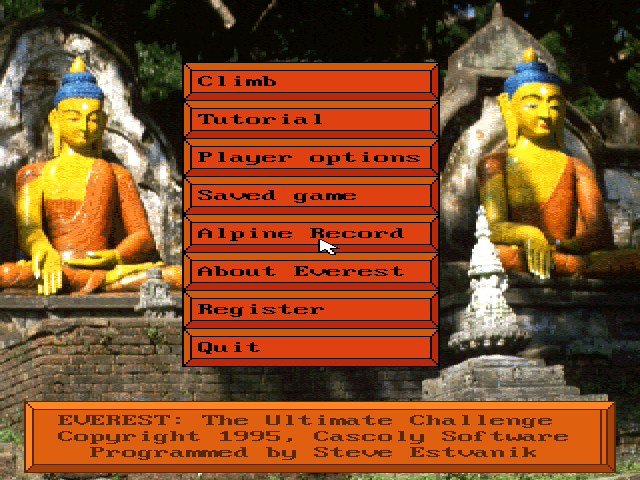
To actually attempt the ultimate summit, you had to register the full game to unlock eight additional peaks, including brutal challenges like Annapurna and Kangchenjunga. Period coverage from outlets like DOSGames.com gave the title high marks for its visual presentation, but correctly called out how disappointing it was to play a game with Everest in the title without being able to climb it. Furthermore, the dry interface and heavy reliance on menu management meant the gameplay didn't appeal to everyone; if you wanted action, staring at route maps and roster statistics felt more like doing taxes in an icebox than climbing a mountain.
Even modern players digging through abandonware archives get tripped up by the game's strict progression mechanics. You can easily get stuck at early staging areas, like the rally point before Camp 1, if you fail to balance supply weight against team endurance. The MS-DOS system leaves zero room for tactical blunders; if you push your climbers too hard early on, they simply run out of steam long before the summit is in sight.
How to play Everest: The Iceman's Apprentice online today
While configuring memory modes for a 1996 DOS title used to be a chore, you can play 1996's Everest: The Iceman's Apprentice free in your browser right now on this page. If you are interested in historical strategy systems or want to see how developer Cascoly Software turned real Himalayan expeditions into software, it is an unusual experiment in high-altitude planning.
New players usually make the mistake of pushing their team upward as fast as possible, treating the mountain like a race. Take your time, establish extra camps, and stock more oxygen than you think you need before moving beyond base camp. You can play Everest: The Iceman's Apprentice online directly in your browser with no installation needed, giving you instant access to one of the most uncompromising sports management games of the MS-DOS era.
How Everest: The Iceman's Apprentice is played — the keys the game listens to, grouped by what they do.
- Action
- Interface
- Left click — Select menu / Give orders
Highlighted keys are mapped — hover or tap one to see what it does.
Everest: The Iceman's Apprentice is a turn-based simulation controlled primarily via a mouse-driven GUI. Keyboard shortcuts exist for sound and music toggles.
Players' controls
Touch and gamepad controls
The on-screen keyboard and gamepad mapping the browser player uses on a phone, a tablet or a controller, as opposed to the real keys above. $PRO members make their own in the player and share them here; anyone can pick one to play with.
Make your own touch controlsPRO
- 1Open the editorSign in below, then pick what to make. The game starts with the editor open over it.
- 2Place your keysAdd keys and drag them where your thumbs rest, or map a controller's buttons. Test plays the game with them; Save keeps them, and you play with them from then on.
- 3Share themShare them right after saving in the game, or name and share them here. Players vote, and the best become this game's controls for everyone.
Go PROSee how it worksSign in+20 XP for sharing · +50 XP if yours become the game's own
- The game's own controlsKeyboardGamepadWhat every player starts with.In use
2 screenshots
From the archive
No gameplay video yet
No gameplay video for Everest: The Iceman's Apprentice yet. Sign in to add one.
No reviews yet
Tell the community what you think of Everest: The Iceman's Apprentice. Reviews are public and tied to your username.
No archived manuals for Everest: The Iceman's Apprentice yet
No manuals archived for this title yet. Sign in to upload the first scan.
Cheat codes, console commands and memory pokes for Everest: The Iceman's Apprentice — each one verified and attributed.
Sign in to submitNo cheats yet for this title
Know a working cheat, poke or trainer? Add it with the button above. Moderators check every entry before it goes live.
No archived soundtrack for Everest: The Iceman's Apprentice yet
No soundtrack archived for this title yet. Sign in to upload the first rip.
No save states for Everest: The Iceman's Apprentice yet
No save states for this title yet. Sign in to share one.
Discussions
Sign in to post- Threads0
- Total posts0
- Online now6
Community · Everest: The Iceman's Apprentice
Who's contributing, and what's new
- Reviews0
- Threads0
- Uploadsapproved0
- Contributors0
Recent activity
Nothing here yet
Reviews, discussion threads and approved uploads appear here as members add them.