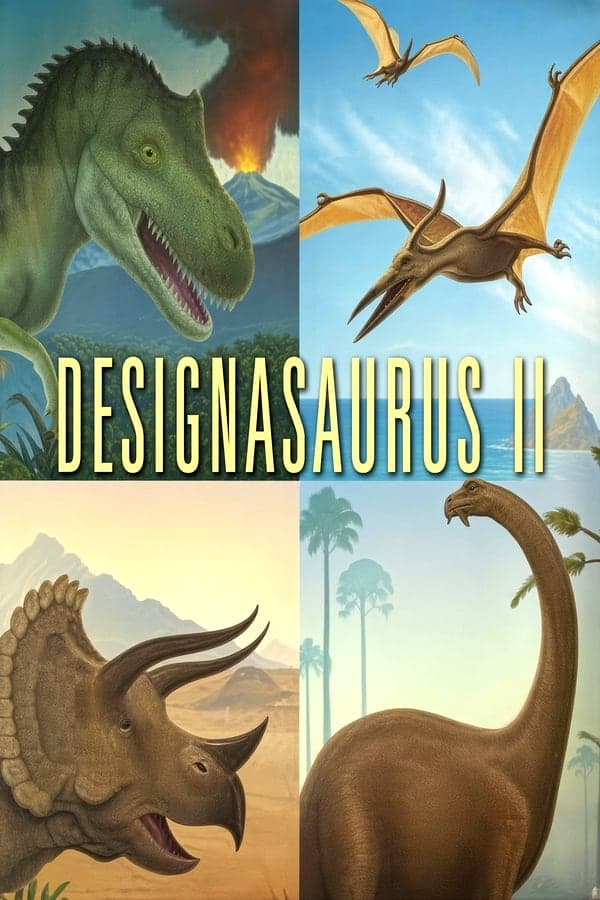
aka Designasaurus 2
Designasaurus II hands you the keys to genetic modification in 2501, asking you to stitch together prehistoric predators and survive the Mesozoic era to save the future.
Visual Concepts Entertainment took a bizarre premise for this 1990 MS-DOS game and built a real-time survival loop around it. Rogue scientist Dr. Max von Fusion has stolen 16 geneprints of the fictional Gigantodon and scattered them across ancient earth, leaving it up to the Designasaurus Research Foundation to send a genetically engineered specimen back in time to retrieve them. You begin in a lab interface where you can assemble a monster out of disparate parts, combining the skull of an Allosaurus, the body of an Apatosaurus, the spiked tail of an Ankylosaurus, and the crested head of a Corythosaurus.
Once you step out of the time machine, the top-down perspective shifts the focus entirely to survival. You walk your creature across Triassic, Jurassic, and Cretaceous landscapes, keeping a constant eye on basic biological needs. Eat smaller dinos if you built a carnivore, graze on prehistoric flora if you chose plant-eating parts, and find a mate of the same species to lay eggs. You even have to stand guard over your nest and feed the hatchlings while hunting down the missing geneprints tucked away in the wilderness.
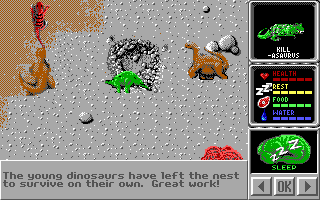
The core tension comes down to ruthless resource management. Moving across the map drains your energy, and running low on food transforms a quiet exploration run into a desperate panic. If you built a massive herbivore with heavy armor, you need a constant supply of greens just to keep moving, while a swift predator has to keep catching prey before its stamina bar empties completely. Stress spikes fast when you venture into a barren ecozone with an empty stomach and a pack of hostile carnivores on your tail.
Published by Britannica Software, the game tried to strike a balance between real paleontology and arcade action, brought on board consulting paleontologist Dr. Peter V. Rodda to keep the science grounded. Yet for all the academic oversight, a few of the in-game trivia pop-ups ended up wildly off-kilter, giving players a strange mix of real dinosaur facts and bizarre misstatements that could have used extra editing. Another quirk that fans of the original release fondly remember was the built-in print utility: if you were proud of your hybrid creation, you could send its design directly to your dot-matrix printer to keep a paper printout of your custom beast.
For all its clever mechanics, the game suffers from a lack of clear pacing once you get past the initial excitement of creating your creature. Navigating the flat terrain while managing hunger wears down its welcome during long sessions, especially since finding the hidden geneprints relies heavily on wandering across large, featureless terrain. Programmers Scott L. Patterson and Gregory A. Thomas crafted a fun foundation, but the moment-to-moment combat lacks deep feedback, turning fights with rival beasts into simple stat checks and collision bumping.
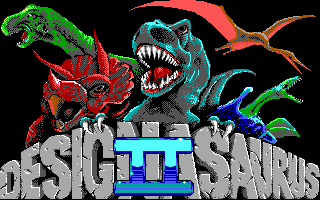
If you compare it to other action games from 1990, the visual presentation is clean but basic, leaning on simple shapes and colors to keep the action smooth on standard PC setups. It does not match the graphical detail or arcade tightness of dedicated action titles from the same year, but its mix of custom genetics and territorial survival gave it a feel unlike almost anything else on the market.
While getting original MS-DOS diskettes to run on modern hardware usually feels like trying to decipher an ancient language, you can leap straight into the time portal right now. You can play Designasaurus II online as a Designasaurus II MS-DOS game straight from this page with zero hassle. Assemble your first hybrid monstrosity in the lab, drop into the Triassic period, and see if you can manage your hunger bar long enough to raise a family and save the future.
Designasaurus II hands you the keys to genetic modification in 2501, asking you to stitch together prehistoric predators and survive the Mesozoic era to save the future.
Visual Concepts Entertainment took a bizarre premise for this 1990 MS-DOS game and built a real-time survival loop around it. Rogue scientist Dr. Max von Fusion has stolen 16 geneprints of the fictional Gigantodon and scattered them across ancient earth, leaving it up to the Designasaurus Research Foundation to send a genetically engineered specimen back in time to retrieve them. You begin in a lab interface where you can assemble a monster out of disparate parts, combining the skull of an Allosaurus, the body of an Apatosaurus, the spiked tail of an Ankylosaurus, and the crested head of a Corythosaurus.
Once you step out of the time machine, the top-down perspective shifts the focus entirely to survival. You walk your creature across Triassic, Jurassic, and Cretaceous landscapes, keeping a constant eye on basic biological needs. Eat smaller dinos if you built a carnivore, graze on prehistoric flora if you chose plant-eating parts, and find a mate of the same species to lay eggs. You even have to stand guard over your nest and feed the hatchlings while hunting down the missing geneprints tucked away in the wilderness.

The core tension comes down to ruthless resource management. Moving across the map drains your energy, and running low on food transforms a quiet exploration run into a desperate panic. If you built a massive herbivore with heavy armor, you need a constant supply of greens just to keep moving, while a swift predator has to keep catching prey before its stamina bar empties completely. Stress spikes fast when you venture into a barren ecozone with an empty stomach and a pack of hostile carnivores on your tail.
Published by Britannica Software, the game tried to strike a balance between real paleontology and arcade action, brought on board consulting paleontologist Dr. Peter V. Rodda to keep the science grounded. Yet for all the academic oversight, a few of the in-game trivia pop-ups ended up wildly off-kilter, giving players a strange mix of real dinosaur facts and bizarre misstatements that could have used extra editing. Another quirk that fans of the original release fondly remember was the built-in print utility: if you were proud of your hybrid creation, you could send its design directly to your dot-matrix printer to keep a paper printout of your custom beast.

For all its clever mechanics, the game suffers from a lack of clear pacing once you get past the initial excitement of creating your creature. Navigating the flat terrain while managing hunger wears down its welcome during long sessions, especially since finding the hidden geneprints relies heavily on wandering across large, featureless terrain. Programmers Scott L. Patterson and Gregory A. Thomas crafted a fun foundation, but the moment-to-moment combat lacks deep feedback, turning fights with rival beasts into simple stat checks and collision bumping.
If you compare it to other action games from 1990, the visual presentation is clean but basic, leaning on simple shapes and colors to keep the action smooth on standard PC setups. It does not match the graphical detail or arcade tightness of dedicated action titles from the same year, but its mix of custom genetics and territorial survival gave it a feel unlike almost anything else on the market.
While getting original MS-DOS diskettes to run on modern hardware usually feels like trying to decipher an ancient language, you can leap straight into the time portal right now. You can play Designasaurus II online as a Designasaurus II MS-DOS game straight from this page with zero hassle. Assemble your first hybrid monstrosity in the lab, drop into the Triassic period, and see if you can manage your hunger bar long enough to raise a family and save the future.
How Designasaurus II is played — the keys the game listens to, grouped by what they do.
Highlighted keys are mapped — hover or tap one to see what it does.
Specific keyboard controls for dinosaur movement and actions in Exploration Mode are not documented in the manual source provided.
The on-screen keyboard and gamepad mapping the browser player uses on a phone, a tablet or a controller, as opposed to the real keys above. $PRO members make their own in the player and share them here; anyone can pick one to play with.
Cheat codes, console commands and memory pokes for Designasaurus II — each one verified and attributed.
Sign in to submitHow Designasaurus II is played — the keys the game listens to, grouped by what they do.
Highlighted keys are mapped — hover or tap one to see what it does.
Specific keyboard controls for dinosaur movement and actions in Exploration Mode are not documented in the manual source provided.
The on-screen keyboard and gamepad mapping the browser player uses on a phone, a tablet or a controller, as opposed to the real keys above. $PRO members make their own in the player and share them here; anyone can pick one to play with.
Cheat codes, console commands and memory pokes for Designasaurus II — each one verified and attributed.
Sign in to submit